Sólheimajökull Glacier: Seeing Climate Change Up Close
Visit Sólheimajökull glacier in Iceland. Learn about its volcanic ash streaks, dramatic retreat, glacier hiking options, and what climate change looks like up close.
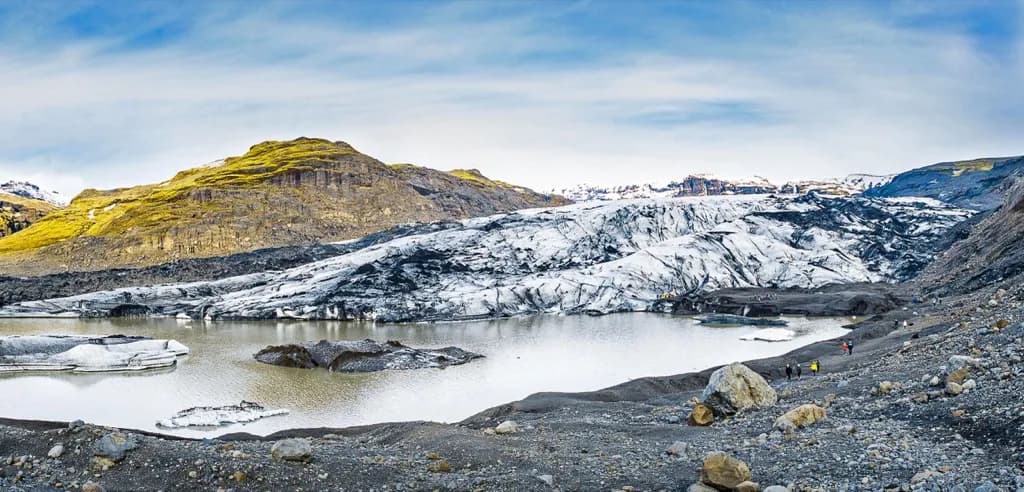
There are places where you read about climate change, and there are places where you see it. Sólheimajökull is the second kind.
Sólheimajökull ("SOLE-hay-ma-yo-kutl") is an outlet glacier of Mýrdalsjökull, the fourth largest ice cap in Iceland. It flows down between two mountains toward the lowlands, and for most of the last century, its snout reached almost to the road. Not anymore. Since the 1990s, it has retreated dramatically and continuously. The lagoon at its base, which barely existed in the 1990s, now stretches hundreds of meters in front of the ice.
I first visited Sólheimajökull as a kid, and I've been back many times since. Each time, there's noticeably more water and less ice. It's the kind of thing that's hard to process until you're standing there, looking at where the glacier used to end and seeing bare rock and a growing lake instead.
What You're Looking At
Sólheimajökull is about 8 km long and descends from the ice cap to about 100 meters elevation at its current terminus. Katla, one of Iceland's most active volcanoes, sits beneath the Mýrdalsjökull ice cap directly above the glacier.
And that volcanic connection is what makes Sólheimajökull visually unlike any glacier you've seen in photographs. The ice is streaked with black and grey volcanic ash from eruptions. Layers of white ice alternate with dark bands of tephra, creating a striped pattern that looks almost painted. In some places, the ash is so concentrated that the ice appears nearly black.
The crevasses deeper in the glacier reveal an intense, almost electric blue. This color comes from the way compressed ice absorbs red light and reflects blue. The combination of blue ice, black ash, and white snow is surreal. No photo does it justice.
At the glacier's edge, you'll see icebergs calving into the lagoon. Some float with that same blue-and-black striping, like fragments of abstract art drifting on grey water.
The Retreat
Scientists have been measuring Sólheimajökull's position since the early 1900s. The data tells a clear story: the glacier advanced slightly during cooler periods in the mid-20th century, but since the 1990s it has retreated dramatically and continuously.
Since 2010, the glacier has retreated by over 700 meters. That's not a subtle change. You can see it in the landscape. The rocks exposed by the retreating ice are smooth, polished, and covered in fresh scratches called striations, carved by the glacier as it moved over them. These rocks were under ice within living memory. Now they're open to the air.
The lagoon at the glacier's base grows every year. It's filled with meltwater, and chunks of ice break off the glacier face and float in it. Walking along the lagoon's edge, you can see the high-water marks and lateral moraines (ridges of debris) that show where the glacier stood 10, 20, 50 years ago. It's a timeline written in rock and sediment.
This isn't political commentary. It's just what's there. Anyone can come, look at the markers, and draw their own conclusions.
Visiting the Glacier
The Free Viewpoint
From the parking lot off Route 221, it's a 15-20 minute walk along a marked gravel path to the glacier viewpoint. The path is easy, mostly flat, and suitable for anyone with reasonable mobility. No special gear needed.
From the viewpoint, you can see the glacier face, the lagoon, and the surrounding moraine landscape. It's a powerful view, and for many people it's enough. You can spend 30-45 minutes here and come away with a real understanding of what a retreating glacier looks like.
Glacier Hiking
If you want to walk on the ice itself, you need a guided tour. This is non-negotiable. Glaciers have crevasses, some of them hidden under snow bridges, and falling into one can be fatal. Guides know the safe routes, provide crampons and ice axes, and will keep you alive.
Several operators run glacier hikes from the parking lot, typically lasting 3-4 hours. You'll strap crampons to your hiking boots, learn to walk on ice, and follow a guide across the glacier surface. You'll see the crevasses up close, the volcanic ash layers in cross-section, and ice formations that you can't see from the viewpoint.
What to bring for a glacier hike: Warm, waterproof layers. Sturdy hiking boots (not sneakers, the crampons won't attach properly). Gloves, a hat, and sunglasses. Water and snacks. The guides provide the technical gear.
Booking: Reserve in advance, especially in summer. Walk-ups are sometimes possible but not guaranteed.
Photography
Sólheimajökull is a photographer's dream, and it rewards patience. The interplay of ice, ash, water, and rock creates compositions everywhere you look.
From the viewpoint: A telephoto lens picks out details in the ice face. The ash striping, the blue crevasses, floating icebergs. A wide-angle captures the scale of the retreat.
On the glacier: If you're on a hiking tour, you'll get close-up opportunities with ice formations, meltwater channels, and volcanic debris embedded in the ice. Macro shots of ice crystals work surprisingly well.
Light: Overcast days are actually ideal. The diffused light brings out the blue in the ice and the contrast in the ash layers. Harsh sunlight can wash everything out.
Best time of day: Morning, before the sun is high enough to create glare off the ice. In summer, the late evening light is also beautiful.
Getting There
Sólheimajökull is on the South Coast route, about 160 km (2 hours) from Reykjavik. Turn off Route 1 onto Route 221 at the signed junction between Skogafoss and Vik. The access road is about 4 km and ends at a parking lot.
Most people visit as part of a South Coast day trip that also includes Seljalandsfoss, Skogafoss, and Reynisfjara. If you're doing a glacier hike, budget extra time and plan accordingly.
There's a small parking fee and basic facilities at the lot. No cafe or restaurant, so bring food if you'll be here for a glacier hike.
Why I Keep Coming Back
I'm not going to lecture you about climate change. But standing in front of a retreating glacier and seeing bare rock where ice used to be, that's different from reading about it. Every time I visit, the lagoon is a little bigger and the ice is a little further away. My kids will see a different glacier than I did.
Sólheimajökull won't be here forever. Not like this. If you're on the South Coast, stop here. It takes 30 minutes from the parking lot and back, and it's one of those stops that sticks with you longer than you expect.
We cover the full geology and the retreat data on the Iceland Local app as part of the South Coast audio tour. But honestly, you don't need narration to understand what's happening here. You just need to look.
Explore Iceland with a Local Guide
Download the app for GPS-triggered audio tours narrated by a real Icelander. Eyes up, phone down.
More from the blog
Apr 9, 2026
Golden Circle or South Coast? How to Choose Your Iceland Day Trip
Golden Circle vs South Coast Iceland: which day trip is better? An honest comparison covering what each offers, best season, and how to choose.
Apr 9, 2026
Hallgrímskirkja: The Story Behind Reykjavik's Iconic Church
The full story of Hallgrímskirkja, Reykjavik's iconic church. Architecture, history, the tower view, pipe organ, and tips for visiting from a local.